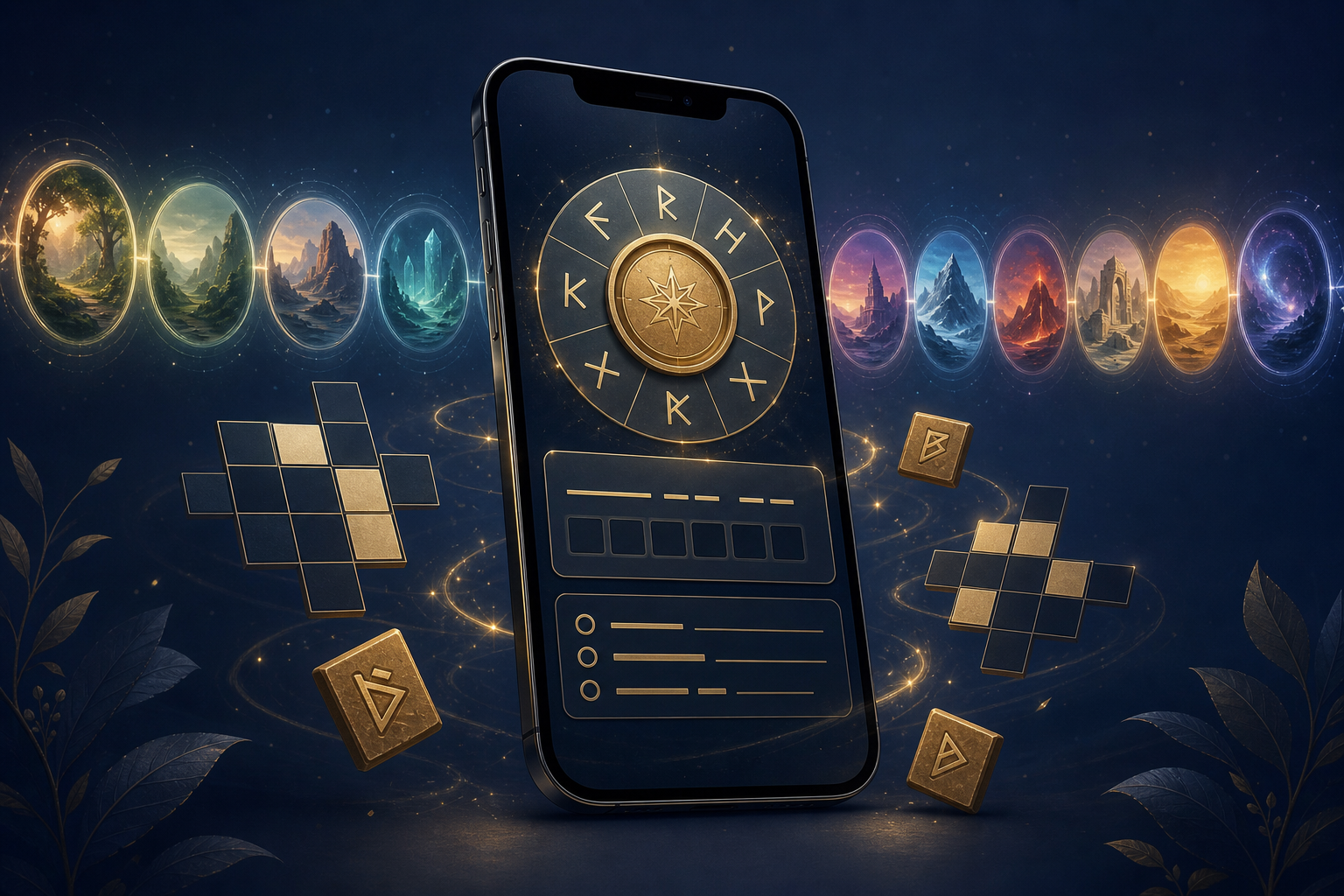
A good word puzzle game should do more than ask you to find hidden words. It should give you a clear goal, a fair challenge, and enough variety to make each session feel worthwhile. Some players want a calm daily puzzle with a cup of coffee. Others want a campaign they can keep returning to, with new boards, themes, and goals to complete over time. RuneWords is built for that second kind of player, while still being easy to enjoy in short sessions. It combines rune wheel solving with clue and crossword-style prompts, a bundled campaign of 1,000 boards, 10 themed realms, daily challenges, coins, runes, hints, and optional Game Center goals. If you are trying to decide what kind of word game belongs on your iPhone, this guide will help you know what to look for.
What is a word puzzle game?
A word puzzle game is any game where the main challenge is forming, finding, completing, or interpreting words. The format can vary widely. Some games ask you to connect letters into words. Some give you crossword clues. Others hide words in a grid, test vocabulary, or ask you to rearrange letters into the correct answer. The best word puzzle games usually balance three things:
- Recognition: spotting possible words from available letters or clues.
- Reasoning: narrowing down answers through meaning, length, theme, or placement.
- Progression: giving you a reason to continue beyond one isolated puzzle. That balance matters. A game that's only about speed can become stressful. A game that's only about vocabulary can feel dry. A game that gives answers away too easily can lose its spark. A satisfying word puzzle game gives you just enough uncertainty to make each solution feel earned.
Common types of word puzzle games
Before choosing a game, it helps to understand the main styles.
Letter wheel word games
In a letter wheel puzzle, you are given a small set of letters and asked to form words from them. The appeal is immediate: the answer is somewhere in front of you, but your brain has to find it. RuneWords uses a rune wheel, which gives the familiar letter-connecting format a themed presentation. This style works well on iPhone because it's simple to understand, touch-friendly, and satisfying in short bursts.
Crossword-style clue games
Clue-based word games give you a prompt, definition, or hint and ask you to solve the intended word. This adds a layer of interpretation. You are not only asking, “What words can I make?” You are also asking, “Which word fits this clue?” RuneWords includes clue and crossword-style prompts, which can make boards feel more purposeful than pure anagram solving. The clue gives you direction, while the rune wheel gives you the letters to work with.
Word search games
Word search games hide words in a grid. They are often relaxing because the challenge is visual recognition rather than clue solving. They can be great for casual play, though some players may prefer more structure or progression.
Daily word challenges
Daily challenges give players a reason to return regularly. A daily puzzle should feel self-contained: something you can complete quickly, enjoy, and move on from. In RuneWords, daily challenges sit alongside the campaign, so you can choose between a quick daily objective and longer realm progression.
What makes a word puzzle game worth keeping?
Many word games are fun for a few minutes. Fewer are built to stay interesting after the first week. Here are the qualities that matter most.
1. Clear rules with room for mastery
A good word puzzle game should be understandable within the first minute. You should know what to tap, drag, submit, or solve without reading a manual. But simple rules should still allow improvement. In a rune wheel game, mastery might mean learning to scan prefixes and suffixes, quickly testing letter combinations, or using clues more efficiently. The controls stay simple, but your solving habits get sharper.
2. Fair difficulty
Fair difficulty is not the same as easy difficulty. A puzzle can be challenging and still feel fair if the answer follows from the clue, the letters, and the game’s rules. A frustrating word puzzle often fails because it feels arbitrary. The clue might be too vague, the accepted word list might feel inconsistent, or the game might push players toward hints too aggressively. A better puzzle gives you enough information to make progress through thought, not guesswork alone.
3. Variety without confusion
Word games can become repetitive when every board feels identical. Variety can come from themes, clue styles, realm progression, daily challenges, or different board goals. RuneWords uses 10 themed realms across its bundled campaign. That structure gives the game a sense of journey without changing the core solving loop so much that players have to relearn the game repeatedly.
4. A progression system that respects the puzzle
Progression can make a word puzzle game more motivating, but it should not distract from the words themselves. Coins, runes, hints, realm completion, and optional goals work best when they support the main activity rather than replacing it. For example, hints can help when you are genuinely stuck. Coins can give a sense of earning resources through play. Optional Game Center goals can add extra motivation for players who enjoy completion, while remaining unnecessary for players who simply want to solve boards.
5. Short-session friendliness
Many iPhone players open a word game during small breaks: on the couch, while waiting, or before bed. A good mobile word puzzle game should make it easy to complete something meaningful in a few minutes. Daily challenges are useful here. So are boards that can be solved without a long setup. The ideal experience is one where you can play briefly, make progress, and return later without feeling lost.
How RuneWords fits the word puzzle game category
RuneWords is an iPhone word puzzle game built around a campaign structure. Instead of relying only on endless random puzzles, it includes 1,000 bundled campaign boards spread across 10 themed realms. The core interaction is the rune wheel, where players solve words using available letters and clue or crossword-style prompts. That combination gives the game a few distinct strengths:
- The rune wheel keeps input simple and tactile.
- Clue-based prompts add direction and meaning.
- Realm progression gives players a longer path to follow.
- Daily challenges provide a fresh reason to check in.
- Coins, runes, and hints support the solving loop.
- Optional Game Center goals add extra objectives for players who want them. The result is a word puzzle game for players who enjoy both individual puzzles and a sense of campaign progression.
Practical tips for solving rune wheel word puzzles
Whether you are playing RuneWords or another letter wheel game, a few habits can make solving more enjoyable.
Start with the clue, not the letters
If a board includes a clue, read it carefully before testing random combinations. The clue can narrow the answer by meaning, tone, or category. Ask yourself: is the clue pointing to an object, an action, a description, or a phrase-like idea?
Look for common word shapes
Many English words share familiar patterns. Try scanning for:
- common endings like -ed, -er, -ing, or -ly
- common beginnings like re-, un-, pre-, or st-
- vowel-consonant patterns that form natural syllables You don't need to be a vocabulary expert. Pattern recognition often matters more than knowing rare words.
Rearrange your focus
If you keep seeing the same non-answer, stop looking at the letters in the same order. Mentally move a different letter to the front. In wheel-based games, the circular layout can make certain combinations stand out while hiding others.
Use hints when they preserve fun
Hints are best used when a puzzle has stopped being satisfying. If you have thought through the clue, tested reasonable combinations, and still feel stuck, a hint can turn frustration back into momentum. The goal is not to avoid every hint forever. The goal is to keep the game enjoyable while still giving yourself the pleasure of solving.
Take breaks on stubborn boards
Word puzzles often benefit from a reset. If an answer is not coming, leave the board and return later. Your brain may stop looping on the same wrong pattern and spot the answer quickly when you come back.
How to choose the right word puzzle game for you
The best word puzzle game is the one that matches your play style. Before downloading, consider these questions:
Do you prefer clues or pure letter finding? If you like crossword-style thinking, choose a game with prompts or definitions.
Do you want a campaign or endless casual play? A campaign gives you long-term structure. Endless play is better if you only want quick, disconnected sessions.
Do you enjoy progression systems? Coins, hints, collectibles, realms, and goals can add motivation, as long as they don't overwhelm the puzzles.
Do you play daily? If so, daily challenges can make the game feel more alive.
Do you care about optional achievements? Game Center goals can be a nice extra if you enjoy tracking completion. RuneWords is a good fit if you want an iPhone word puzzle game with a structured campaign, themed realms, clue-supported solving, and daily challenges, rather than only a simple list of unrelated puzzles.
Final thoughts
A strong word puzzle game should feel clear, fair, and rewarding. It should invite you to think without making the experience feel like homework. It should also give you a reason to return, whether that reason is a daily challenge, a new realm, a satisfying clue, or the simple pleasure of seeing a word click into place. RuneWords brings those pieces together through rune wheel solving, clue and crossword-style prompts, 1,000 bundled campaign boards, 10 themed realms, daily challenges, coins, runes, hints, and optional Game Center goals. If you enjoy word games with a little atmosphere and a steady path forward, it's worth exploring.