Some word games ask, “How many words can you make from these letters?” Clue-based word games ask a sharper question: “Which word does this prompt want?”
That difference matters. In word games with clues, the puzzle is not just about spotting letter patterns. It is about reading a prompt, understanding its intent, and using the available letters to prove or revise your answer. The clue gives the board a direction. The letters give it limits. The answer sits where those two things meet.
For iPhone players, that format can be especially satisfying. It brings a bit of crossword-style thinking into a lighter, touch-friendly puzzle session. You can open a board, read the clue, test an idea, and move forward without committing to a full crossword grid.
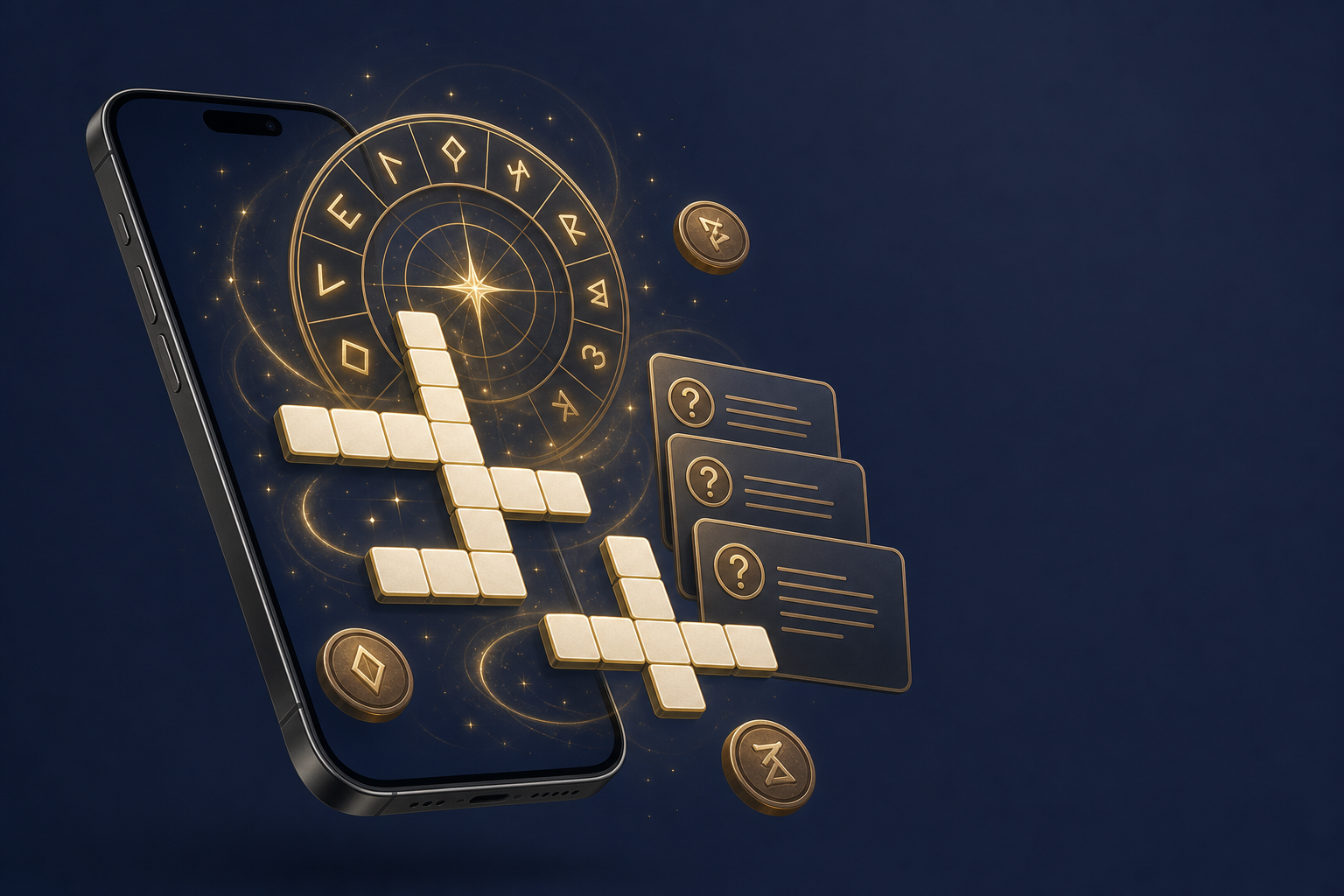
RuneWords fits this style with a rune wheel, clue/crossword-style prompts, 1,000 bundled campaign boards, 10 themed realms, daily challenges, coins, runes, hints, and optional Game Center goals. Here is what makes clue-led word games work well, and what to look for if you enjoy this kind of puzzle.
What Makes a Word Game “Clue-First”?
A clue-first word game starts with meaning. The prompt may be direct, descriptive, category-based, or crossword-like, but it gives you a reason to search for a specific answer.
A clue might point toward:
- A synonym or related word
- A common object or action
- A category or group
- A short descriptive idea
- A definition-style answer
- A phrase that requires a small shift in thinking
This is different from open anagram solving. In a pure anagram game, you may scan the letters and try any valid word that appears. In a clue-first game, a word is not enough just because it can be spelled. It also has to answer the prompt.
That extra requirement changes the feel of the puzzle. The challenge becomes less about producing as many possibilities as possible and more about finding the one possibility that makes the clue click.
Clue Solving vs. Open Anagram Solving
Both styles can be enjoyable, but they reward different habits.
Open anagram solving often begins with the letters. You look for prefixes, endings, short words, repeated patterns, or familiar combinations. The board feels like a field of possible discoveries.
Clue-based solving often begins with interpretation. You ask what kind of answer the prompt is asking for. Is it likely to be a noun? A verb? A quality? A simple definition? A broader idea? Only then do the letters become a filter.
A good clue-based puzzle creates a compact loop:
- Read the clue.
- Decide what type of answer it suggests.
- Scan the available letters.
- Try a likely word.
- Reread the clue if the answer does not fit.
That loop is quick enough for mobile play, but it still gives the satisfying “aha” moment crossword players know well. The clue turns a short word puzzle into a small act of deduction.
Why This Format Works Well on iPhone
Clue-led word games are a natural fit for short sessions because each board has a clear target. You are not opening a large puzzle and wondering where to begin. The prompt gives you a starting point immediately.
That makes the format useful for different moods:
- A quick break when you want one focused puzzle
- A commute or waiting-room session where you may need to stop at any time
- A daily routine built around one compact challenge
- A longer puzzle run when the game includes campaign progression
The best iPhone word games also keep the interface out of the way. Reading the clue, selecting letters, checking the answer, and moving to the next board should feel smooth. The mental effort should come from the puzzle, not from fighting the screen.
What to Look For in Word Games With Clues
Not every clue-based word game has the same rhythm. Some lean closer to crosswords. Some feel more like letter wheels. Some emphasize daily puzzles, while others build a longer campaign. These are the qualities that matter most.
1. Fair clue writing
Fair does not mean easy. A clue can be tricky and still feel fair if the answer makes sense once you see it.
Strong clues usually do three things:
- Point clearly enough to begin thinking
- Match the difficulty of the board
- Reward rereading rather than random guessing
A direct clue might ask for a close synonym. A descriptive clue might circle around an object or action. A broader clue might make you think in a category before narrowing down the word. Variety keeps the game lively, but the player should feel that the clue and answer belong together.
Clues become frustrating when too many unrelated answers seem equally possible, or when the wording depends on information the player could not reasonably infer. In a clue-first game, trust is important: even when you are stuck, you should believe the answer will feel logical in hindsight.
2. A natural letter mechanic
The solving mechanic should support the clue, not distract from it. On iPhone, that means the input method needs to be readable, responsive, and easy to repeat across many boards.
RuneWords uses a rune wheel format. The player reads a clue or crossword-style prompt, studies the available letters on the wheel, and forms the answer from those letters. The wheel gives the puzzle a tactile mobile rhythm: interpret, scan, connect, solve.
This kind of mechanic works well when the clue and the letters keep checking each other. If the clue suggests one idea but the wheel cannot support it, you know to rethink. If the letters suggest a word but the clue does not support it, you keep looking.
3. Progression that gives short puzzles a larger shape
A single clue can be satisfying, but many players also want a sense of movement. Campaign progression gives small boards a larger frame.
RuneWords includes 1,000 bundled campaign boards across 10 themed realms. That structure changes the feel of short sessions. Instead of solving disconnected prompts, you are moving through a mapped sequence of puzzle spaces. One board can still be quick, but the broader campaign gives those quick solves a destination.
Themed realms also make progression easier to feel. You are not only clearing another puzzle; you are advancing through a realm-based path. For players who like mobile games with a campaign arc, that can make clue-solving feel more grounded and less disposable.
4. Daily challenges for a repeatable ritual
Daily challenges suit clue-based word games because they offer a self-contained reason to return. A daily puzzle does not need to replace the main campaign. It can sit beside it as a small routine.
RuneWords includes daily challenges alongside its bundled campaign boards. That gives players two different rhythms: steady realm progress when they want a longer path, and a quick daily solve when they want something brief.
5. Hints that preserve the solve
Hints are most useful when they help you move past a real block without taking away the entire puzzle. In clue-based games, you can get stuck in a few different ways:
- You understand the clue but cannot see the word
- You see possible words but none seem to match the clue
- You have misread the prompt’s intent
- You are close, but one letter pattern is not clicking
RuneWords includes coins, runes, and hints as part of its puzzle economy. As with most word games, hints tend to feel best when used as a nudge after you have tried reading the clue from a few angles.
6. Optional goals for players who like milestones
Some players want a calm puzzle session. Others enjoy achievements, progress markers, or extra goals. Optional systems can serve both groups when they do not interrupt the core solving.
RuneWords includes optional Game Center goals for players who enjoy an added layer of objectives. The main focus remains the clue, the wheel, and the campaign board, while completion-minded players have something else to pursue if they choose.
How RuneWords Fits the Category
RuneWords sits between crossword-style clue solving and mobile word wheel play. It is more directed than an open anagram game because every answer is guided by a prompt. It is lighter than a traditional crossword because the interaction is built around short boards and wheel-based input.
Its core pieces are:
- Clue/crossword-style prompts that guide each answer
- A rune wheel for forming words from available letters
- 1,000 bundled campaign boards
- 10 themed realms for progression
- Daily challenges for short repeatable play
- Coins, runes, and hints to support solving
- Optional Game Center goals for players who enjoy extra objectives
The result is a clue-first word game with a campaign structure. You can treat it as a quick puzzle break, a daily ritual, or a longer journey through the bundled realms.
Practical Tips for Better Clue-Based Solving
If you are used to open word games, clue-led puzzles may ask you to slow down slightly before trying letters. These habits can help.
Identify the answer type first
Before forming words, ask what the clue wants. Is the likely answer a thing, an action, a quality, a place, or an idea? This immediately narrows your search.
Let the clue and letters disagree
If a word appears in the wheel but does not answer the clue, set it aside. If the clue suggests a word that the wheel cannot spell, revise the idea. Progress often comes from letting the prompt and letters correct each other.
Reread short prompts
Short clues are easy to skim. A single word can change the direction of the answer. If your first attempt fails, reread before guessing randomly.
Think in clusters
If a clue suggests speed, think through related ideas such as quickness, motion, racing, or haste. If it suggests sound, think of noise, tone, voice, ring, or echo. Word clusters can lead you to the answer faster than brute-force letter testing.
Notice the game’s clue language
Every clue-based game has a style. Some prompts are direct. Some are more descriptive. Some feel closer to crossword definitions. Paying attention to the way a game phrases its clues can make later boards feel more intuitive.
Use hints when the puzzle has truly stalled
A hint is most satisfying when it keeps a session moving after you have already done the thinking. Try identifying the answer type, checking the letters, and rereading the clue first. If nothing clicks, a hint can be a useful rescue tool.
Who Should Try Word Games With Clues?
Clue-based word games are a strong fit if you enjoy:
- Crossword-style prompts in shorter sessions
- Word wheels or letter-based solving
- Vocabulary, deduction, and pattern recognition
- iPhone word games that are easy to resume
- Campaign progression with optional daily play
- Hints that help when a word is just out of reach
They may be less ideal if you prefer completely open-ended word discovery with no prompt. In this format, the clue is part of the challenge. The fun comes from reading carefully, testing meaning, and finding the word that satisfies both the prompt and the letters.
Final Thoughts
Word games with clues work because they give every answer a purpose. You are not only arranging letters. You are interpreting a prompt, checking it against the available letters, and solving the exact word the clue is pointing toward.
For iPhone players, the strongest versions of this format are readable, fair, quick to control, and supported by enough progression to make short puzzles feel connected.
RuneWords brings that idea into a realm-based word puzzle campaign with a rune wheel, clue/crossword-style prompts, 1,000 bundled boards, 10 themed realms, daily challenges, coins, runes, hints, and optional Game Center goals. If you like crossword thinking in a lighter mobile format, clue-first word puzzles are a format worth exploring.